


What is Onda? It is a body and face contouring treatment that uses 2.45GHz microwave energy, marketed as Coolwaves, to vibrate water molecules inside fat cells and the dermis.
A cooling plate protects the surface, so most people describe a warm massage rather than a sting. Two handpieces are used in a set order.
If you have been scrolling through Seoul clinic menus and Onda keeps appearing next to ultrasound and radiofrequency lifting without anyone explaining how it differs, that confusion is the reason this page exists.
Most menus answer “what is Onda” with the word lifting and leave it there. Microwave energy behaves differently from both, and the difference shows up in what it reaches, what it feels like, and how a session is planned.
By the end you will know which handpiece does what, why the sequence of the two tips changes the outcome more than the total treatment time does, and how many visits a realistic plan involves.
Here at Relieve Clinic in Apgujeong, Seoul, the working principle is that beauty is perfected in comfort. Dr. Park Tae-oh, who has more than fifteen years and over 30,000 clinical cases behind him, consults and treats one-to-one in a private room. Consultation and treatment are the same appointment with the same doctor, and nobody is paid to sell you a package on the way in.
Coolwaves in One Paragraph: Microwave, Not RF or Ultrasound
Onda runs on microwave energy at 2.45GHz, a frequency band its Italian manufacturer, DEKA, brands as Coolwaves. That single detail separates it from everything else on a lifting menu. Ultrasound platforms focus sound waves to a fixed depth.
Monopolar radiofrequency passes current through tissue and heats a broad volume. Microwave energy instead makes water molecules themselves oscillate, and because fat cells and the dermis hold water in different amounts, the energy is absorbed selectively rather than uniformly.
The practical consequence is that the target does not have to be reached by aiming at a millimetre depth. It is reached by choosing a handpiece whose emission profile sits where you want the work done.
DEKA is the manufacturer; you can read the company’s own device description on the DEKA official site if you want the engineering side in the maker’s own words.
Which brings us to the part of Onda that almost no clinic page explains properly: there are two handpieces, and they are not interchangeable.
The Two Handpieces and What Each One Reaches
Onda ships with a 7mm tip and a 3mm tip. They are named for their emission characteristics, and each has one job.
- 7mm tip: reaches deep subcutaneous fat. This is the one used for a double chin, the fatty pad that forms beside the mouth corner, and heavy sagging cheeks. On the body it is the workhorse for the abdomen, flanks and inner thighs.
- 3mm tip: works in the dermis, stimulating collagen and firming the surface. This is the tip that changes how taut skin looks rather than how much volume sits underneath it.
- Cooling plate: built into the handpiece contact surface so the epidermis stays protected while the energy is absorbed below it.
A session on the lower face almost always uses both. A session on the abdomen may lean heavily on the 7mm tip with a lighter surface pass to finish. What varies is not only which tip, but in which order.
Why the Order of the Tips Matters
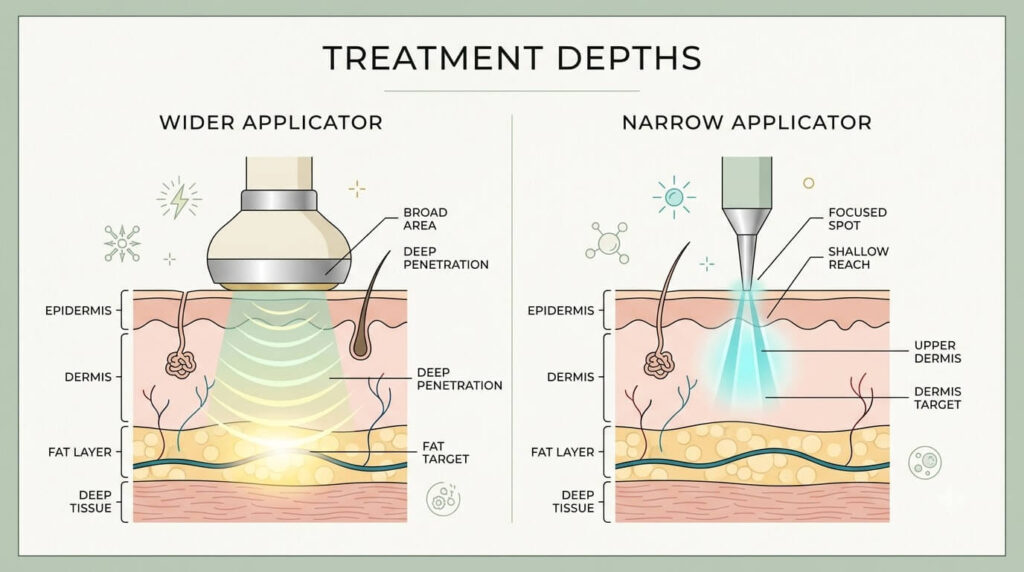
Here is the detail that separates a satisfying Onda result from an underwhelming one. The 7mm tip goes first, addressing the deeper subcutaneous fat layer.
Only then does the 3mm tip pass over the dermis to firm the surface.
Run the sequence backwards and you tighten a surface that is still sitting on an unchanged fat cushion. The skin has been worked on, the underlying volume has not, and the contour barely moves.
Patients who report that Onda did nothing for them have often had exactly that: a surface-first session, or a session that never used the deep tip at all because the clinic ran a single generic protocol on everyone.
At Relieve, Dr. Park maps each session personally rather than handing the patient a fixed template. Which tip, how many passes, which sub-zone of the jawline carries more fat than the other side, whether the mouth-corner pad needs more attention than the submental area.
That mapping is recorded through the clinic’s 3D skin analysis system at consultation, so at the next visit the same region can be compared as measurement rather than as memory.
💡 If you are also weighing Onda lifting cost in Korea for the same trip, that guide covers the part this one does not.
What Onda Lifting Feels Like and Why Numbing Is Usually Skipped
Most patients describe the sensation as a warm massage. The handpiece glides, the warmth builds gradually, and the cooling plate keeps the skin surface comfortable throughout.
It is not the prickling sensation that focused ultrasound produces at each shot.
Because of that, numbing cream is usually not required for Onda. That has a scheduling benefit worth knowing if you are visiting Seoul on a tight itinerary: there is no thirty-to-fifty-minute wait for anaesthetic cream to take effect before the session can start.
You arrive, you are mapped, you are treated.
Comfort still varies by region. Areas where bone sits close to the surface register more warmth than fleshy zones do, and anyone who has had energy-based lifting before will recognise that pattern.
Tell the doctor during the pass; energy settings are adjustable mid-session.
Face Versus Body: The Same Device, Two Different Plans
On the face, the goal is usually definition: a cleaner submental line, less heaviness at the jaw, firmer cheeks. The fat volumes involved are small, so precision matters more than coverage, and the 3mm surface pass carries real weight in the final look.
On the body, coverage matters more. Abdomen and flanks are larger canvases where the deep tip does most of the work across many passes.
Onda is a contouring tool in both settings, which is a different proposition from injectable approaches. If your concern is specifically a submental pocket, it is worth reading how fat-dissolving injections in Korea are planned before deciding which route suits your timeline.
Once what is Onda has a concrete answer, patients usually compare it with the ultrasound and monopolar options on the same menu. The table below sets out where each sits.
| Platform | Energy type | Main target | Typical sensation |
| Onda | 2.45GHz microwave (Coolwaves) | Deep subcutaneous fat, then dermis | Warm massage; numbing usually skipped |
| Ultherapy Prime | Micro-focused ultrasound at 1.5 / 3.0 / 4.5mm | Structural layers, including SMAS at 4.5mm | Warm prickling at each shot, fading in a second or two |
| Thermage FLX | Monopolar radiofrequency | Dermis to upper subcutaneous fat, heated as a broad volume | Warm and tolerable; vibrating cooled handpiece |
| Titanium HIFU | Focused ultrasound | Structural lifting energy category | Comparable to other focused ultrasound platforms |
None of these replaces another. A jawline that is heavy because of fat and slack because of collagen loss is two problems, and a sensible plan may combine tools.
That is also why non-surgical lifting in Korea is better understood as a category of layered choices than as a single procedure. For the radiofrequency side of that comparison specifically, our breakdown of RF skin tightening cost covers how those sessions are quoted.
Sessions, Spacing, and When the Onda Result Peaks
Onda is planned as a short course rather than a single appointment. Two to three sessions, spaced roughly four weeks apart, is the standard structure.
The visible peak arrives around two to three months after the final session, because collagen remodelling continues well past the last handpiece pass.
| Stage | Timing | What is typically noticed |
| Session 1 | Day 0 | Mild warmth and flushing that settles the same day |
| Session 2 | About 4 weeks later | Early softening of contour in the treated zone |
| Session 3 (if planned) | About 8 weeks from the start | Definition becomes easier to see in photographs and in the mirror |
| Peak | 2 to 3 months after the final session | Collagen remodelling completes and the contour settles |
For international patients this shape of timeline raises an obvious question: what happens once you fly home mid-course?
Relieve runs remote follow-up after departure, so a session plan started in Seoul can be reviewed without a second flight. English coordinators are on site throughout, and Arabic enquiries are handled over WhatsApp.
Before You Book Onda in Seoul
By now what is Onda has a practical answer: a microwave device with two tips, used in a set order. Ask three things at consultation.
Which tip will be used on which zone. Whether the deep pass comes before the surface pass. Whether the doctor doing the mapping is the doctor holding the handpiece.
At Relieve the consulting doctor is the treating doctor, and only two or three patients are booked per hour, which is what makes personal mapping possible rather than aspirational.
One practical note on payment. Since 1 January 2026 the VAT refund for foreign patients receiving aesthetic treatment in Korea has ended.
The quoted figure plus 10% VAT is your final out-of-pocket cost, and there is no refund counter at the airport. Any guide still telling you to claim it back on departure is out of date.
This article is general information, not a diagnosis. Individual results vary with skin thickness, fat distribution, age and lifestyle, and suitability can only be determined in an in-person consultation with a licensed doctor.
Book Your Complimentary Skin Assessment
What is Onda lifting in simple terms?
It is a contouring treatment that uses 2.45GHz microwave energy, branded Coolwaves by its manufacturer DEKA, to act on water molecules in fat cells and the dermis. A 7mm handpiece works on deep subcutaneous fat and a 3mm handpiece firms the dermis.
Does Onda lifting hurt?
Most patients describe a warm massage rather than a sting, because a cooling plate protects the skin surface. Numbing cream is usually not needed, which also removes the waiting time before a session starts.
How many Onda sessions will I need in Seoul?
Two to three sessions about four weeks apart is the usual plan, with the result peaking two to three months after the last one. The exact number depends on your fat distribution and is decided at consultation.

Dr. Park Tae-oh is the founder and director of Relieve Clinic Seoul in Apgujeong, Gangnam, where he performs consultation and treatment personally. His work centers on reducing discomfort during aesthetic dermatology, drawing on more than 30,000 clinical cases. In June 2026 he demonstrated periorbital radiofrequency technique using XERF at Cynosure Lutronic Academy Korea.
🎁 First-time visitor? Get FREE Recovery Care (₩100,000 value)
Fill Out the Form Now→